
Coffee develops its aroma and flavour during roasting, but preserving these qualities until consumption depends on effective packaging. Once packed, coffee quality is influenced by oxygen, moisture, light and the carbon dioxide released by roasted beans. In this article, we explore how these factors affect coffee quality and which packaging features help preserve its sensory properties throughout its declared shelf life.
Processes occurring in coffee after roasting
After roasting, coffee beans continue to release carbon dioxide (CO₂) in a process known as degassing. It is most intensive during the first few days, although its duration depends on the coffee variety, roast level and bean structure, as well as the grind size.
At the same time, oxidation occurs as oxygen reacts with coffee’s aromatic compounds and oils. This process diminishes aroma intensity and alters the flavour profile. During prolonged storage, it can also lead to rancid notes.
Factors affecting coffee quality
-
Oxygen
It is a key driver of oxidation. Minimising the product’s exposure to oxygen helps preserve its aroma and flavour for longer.
-
Moisture
Coffee is hygroscopic, meaning it absorbs moisture from the surrounding air. Moisture uptake can compromise its quality, while ground coffee may clump and lose its free-flowing properties.
-
Light
Exposure to light can accelerate the degradation of aroma compounds, making light protection an important packaging requirement.
Barrier properties are essential for another reason, too: effective packaging not only limits oxygen ingress but also helps retain volatile aromatic compounds within the pack.
Why does coffee packaging need a degassing valve?
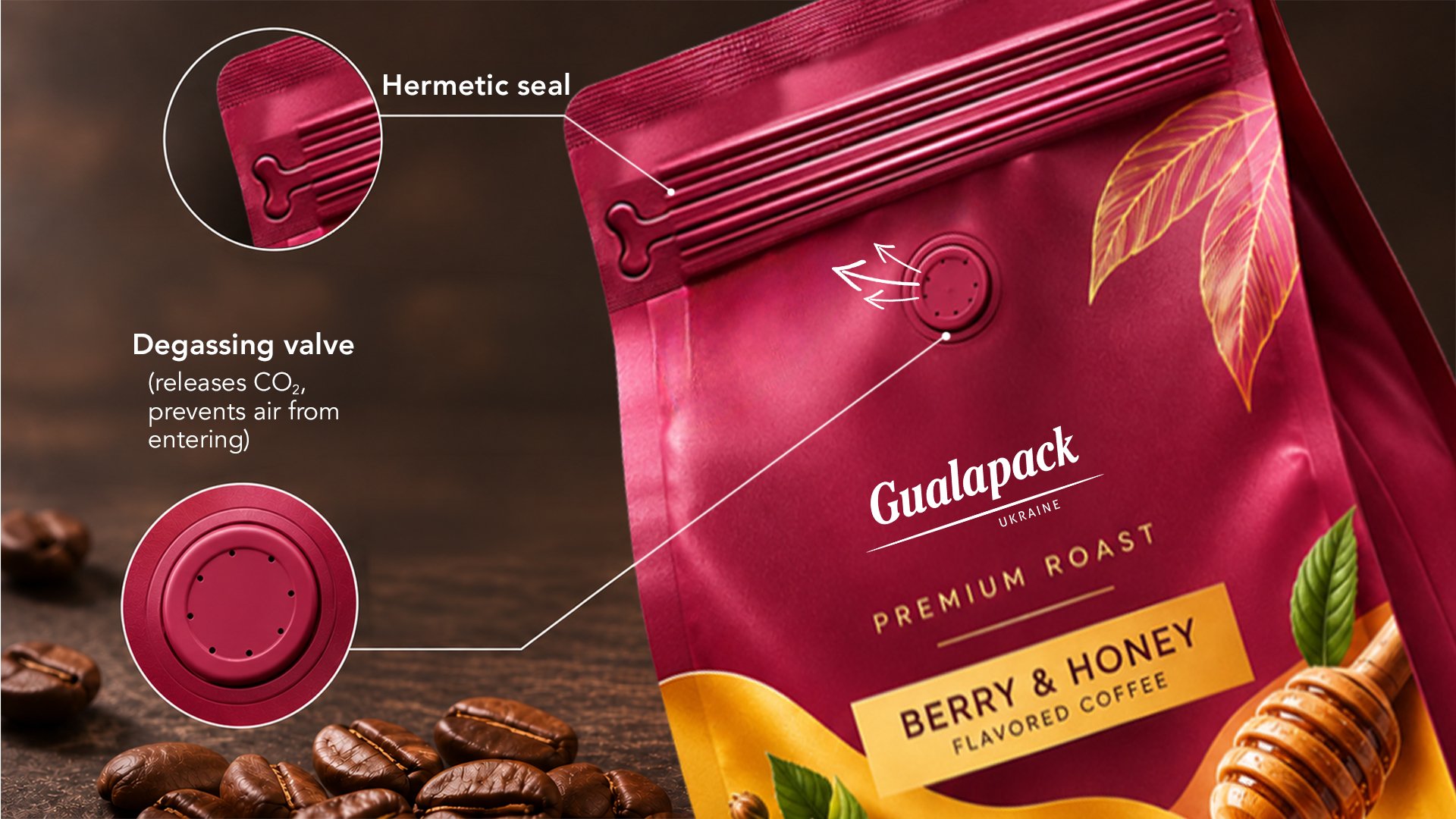
Freshly roasted coffee beans release CO₂. In a sealed pouch without a valve, this gas can accumulate, causing the pack to swell and placing additional stress on the seals. A one-way degassing valve allows excess gas to escape while limiting the ingress of air. It regulates internal pressure but does not replace the barrier structure: protection against oxygen is provided by the packaging material itself. Degassing valves are generally recommended for freshly roasted whole-bean coffee.
Whole bean vs. ground coffee: different packaging requirements
Once coffee is ground, its surface area exposed to air increases approximately ninefold. As a result, ground coffee loses its aroma more rapidly, placing higher demands on the barrier performance of its packaging.
|
Parameter |
Whole bean coffee |
Ground coffee |
|
Exposure to air |
Limited; many aromatic compounds remain within the bean’s structure. |
Grinding significantly increases the surface area exposed to air. |
|
Rate of aroma loss |
Lower |
Higher |
|
CO₂ release |
Most intense in the first few days after roasting. |
Faster gas release, a significant proportion of CO₂ escapes during and after grinding. |
|
Degassing valve |
Usually advisable for freshly roasted coffee. |
Depends on the time between grinding and packaging. |
|
Effect of moisture |
Loss of freshness and deterioration in flavour. |
Loss of freshness and flavour, with an increased risk of caking and clumping. |
|
Barrier requirements |
High |
Higher than for whole bean coffee. |
The packaging structure can be either multilayer or monomaterial. The choice depends on the required barrier performance, target shelf life and processing conditions. To learn more about monomaterial solutions, see our article on monomaterial packaging.
How to preserve coffee aroma and freshness: key principles
Preserving coffee quality requires a combination of measures:
-
limit oxygen exposure: choose a material with adequate barrier properties and ensure the seals are airtight;
-
protect against moisture to prevent quality deterioration;
-
shield the coffee from light to help preserve its sensory properties;
-
for freshly roasted whole beans, include a degassing valve to release excess CO₂;
-
for ground coffee, choose a packaging structure with higher barrier performance, particularly against oxygen and moisture;
-
match the material to the required shelf life and storage conditions;
-
for coffee intended to be consumed over an extended period, choose a resealable pack, for example with a zip-lock fastening.
Once the pack has been opened, the coffee should be sealed tightly and stored in a dry place away from direct light.
Frequently Asked Questions
Is a degassing valve necessary for ground coffee?
It depends on when the coffee is packaged. Freshly ground coffee releases carbon dioxide rapidly, so the need for a valve depends on the production process, including the resting period before packaging and the expected storage conditions.
Can coffee packaging be recyclable?
Yes, recyclable packaging can be made from monomaterial structures. However, these must provide sufficient barrier properties to protect the coffee and maintain its quality throughout the required shelf life.
Why does ground coffee lose its aroma more quickly than whole beans?
Grinding significantly increases the coffee’s surface area exposed to air. This accelerates the loss of volatile aromatic compounds and their oxidation, making effective barrier protection even more critical ground coffee.
Can a degassing valve replace barrier packaging?
No. The valve regulates internal pressure by allowing carbon dioxide to escape, while the packaging material provides the barrier against oxygen, moisture and, where required, light.
How long does coffee stay fresh in its packaging?
Shelf life depends on the type of coffee, roast level, packaging barrier properties and storage conditions.
Key points to remember
Coffee aroma and freshness depend on how effectively the product is protected from oxygen, moisture and light, as well as on the proper release of CO₂ after roasting. Whole bean and ground coffee have different packaging requirements, with ground coffee requiring more effective protection due to its greater surface area exposed to air. The material structure and functional features of the packaging must therefore be tailored to the specific coffee type, packaging process and required shelf life.
Gualapack Ukraine manufactures coffee packaging in Flat Bottom, Side Gusset and Doypack formats, with options including a degassing valve, zip fastener, tear notches and various finishes. We select the laminate structure to match the coffee type, roast level and required shelf life. Explore our FABRYKA KAVY GROUP case study to see how this has been implemented.
Whether you’re developing a new product or evaluating your existing packaging, we’re ready to discuss your coffee’s characteristics, the most suitable packaging format and the required shelf life.
Please get in touch.