
Packaging plays a crucial role in protecting products, extending shelf life, optimizing logistics, and reducing food waste. Without it, achieving today’s scale of food production and distribution would be far more challenging. At the same time, packaging has become central to conversations about responsible consumption — particularly when it comes to single-use flexible packaging that is now part of everyday life.
A paradox worth knowing
Flexible packaging stands out as one of the most resource-efficient formats from a life cycle perspective. Compared to glass, metal, or rigid plastic containers, it requires less material, weighs less, and produces fewer emissions during transportation. LCA (Life Cycle Assessment) studies consistently show that its carbon footprint is often lower than that of alternative packaging formats.
At the same time, flexible packaging remains one of the most challenging materials to recycle – a consequence of decades of technological development focused primarily on functionality.
What makes recycling so challenging?
Most modern flexible packaging is made from multilayer laminates. These combine polymers such as PET, PE, PP — often enhanced with materials like aluminum or nylon — to provide strong barrier properties. This structure protects products from oxygen, moisture, and light, helping extend shelf life and maintain quality.
However, these same advantages create a major drawback at the end of the packaging’s life cycle. Once used, separating the different layers is extremely difficult. Conventional sorting and recycling systems aren’t equipped to handle such complex materials. As a result, a large share of flexible packaging is either incinerated or sent to landfill – even when consumers dispose of it correctly.
A new approach: designing with the future in mind
That is why the industry is shifting toward a fundamentally different mindset — Design for Recycling. The concept focuses on considering a package’s end-of-life already at the design stage: can it be sorted, processed in existing recycling streams, and how complex is its material composition?
In practice, this means simplifying structures, reducing the number of components, and moving toward mono-material solutions — typically based on a single polymer such as PE or PP. These materials are easier to identify, don’t require complex separation, and can be efficiently recycled back into production. As a result, mono-material packaging is emerging as one of the fastest-growing segments in the industry.
What forward-thinking solutions has Gualapack Ukraine already implemented?
The shift to recyclable packaging is not just a strategy – it’s already reflected in practical solutions on the market. At Gualapack Ukraine, this approach is realized through packaging formats that combine functionality, consumer convenience, and alignment with circular economy principles.
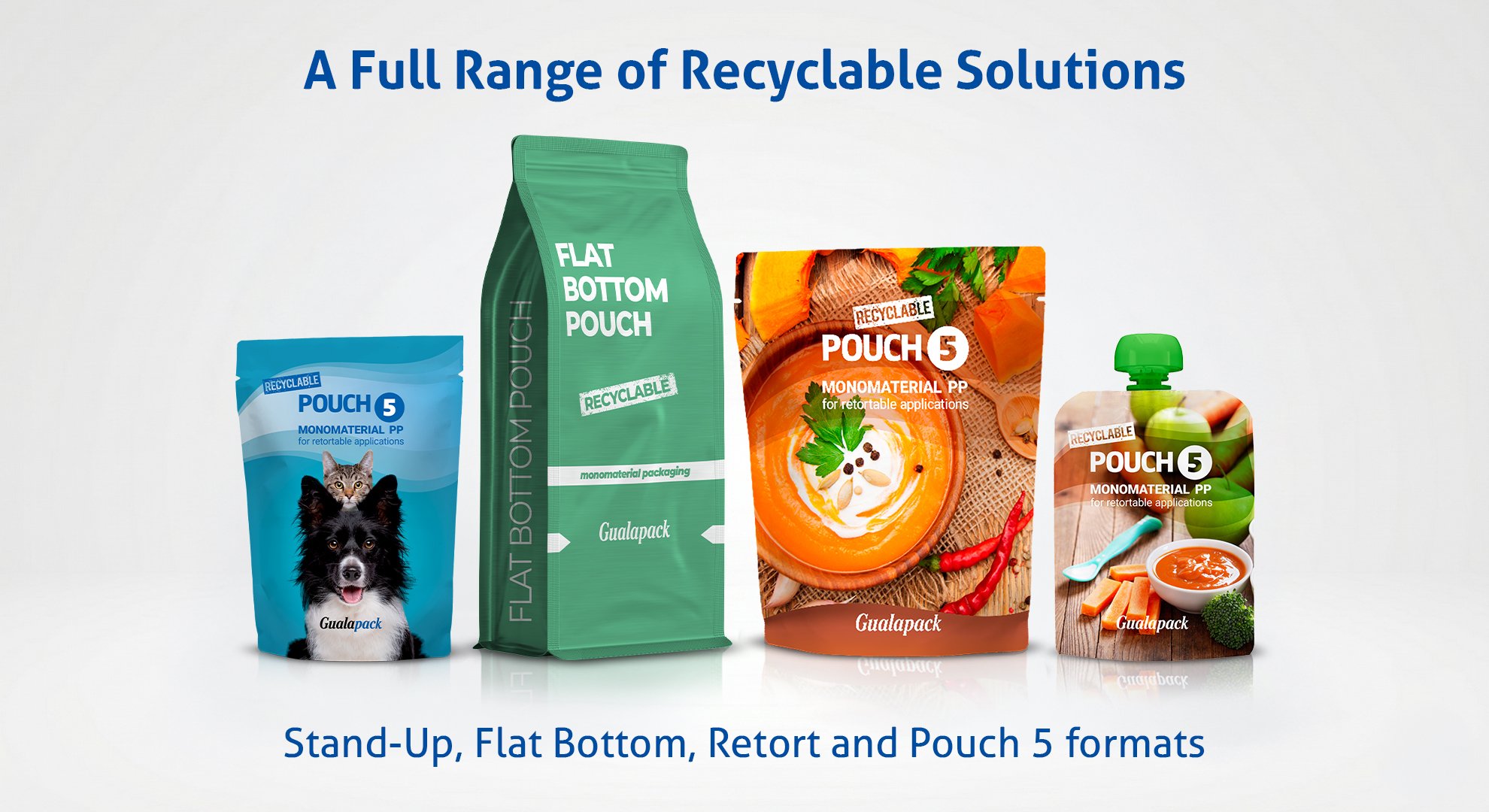
Mono-material packaging: Flat Bottom Pouch, Pouch 5®, Stand Up Pouch
These solutions are developed using polymers from a single group (PE or PP), which significantly improve recyclability by making materials easier to identify and process without complex sorting.
Among the formats already in use:
-
Flat Bottom Pouch — combines strong shelf stability with ample space for brand presentation.
-
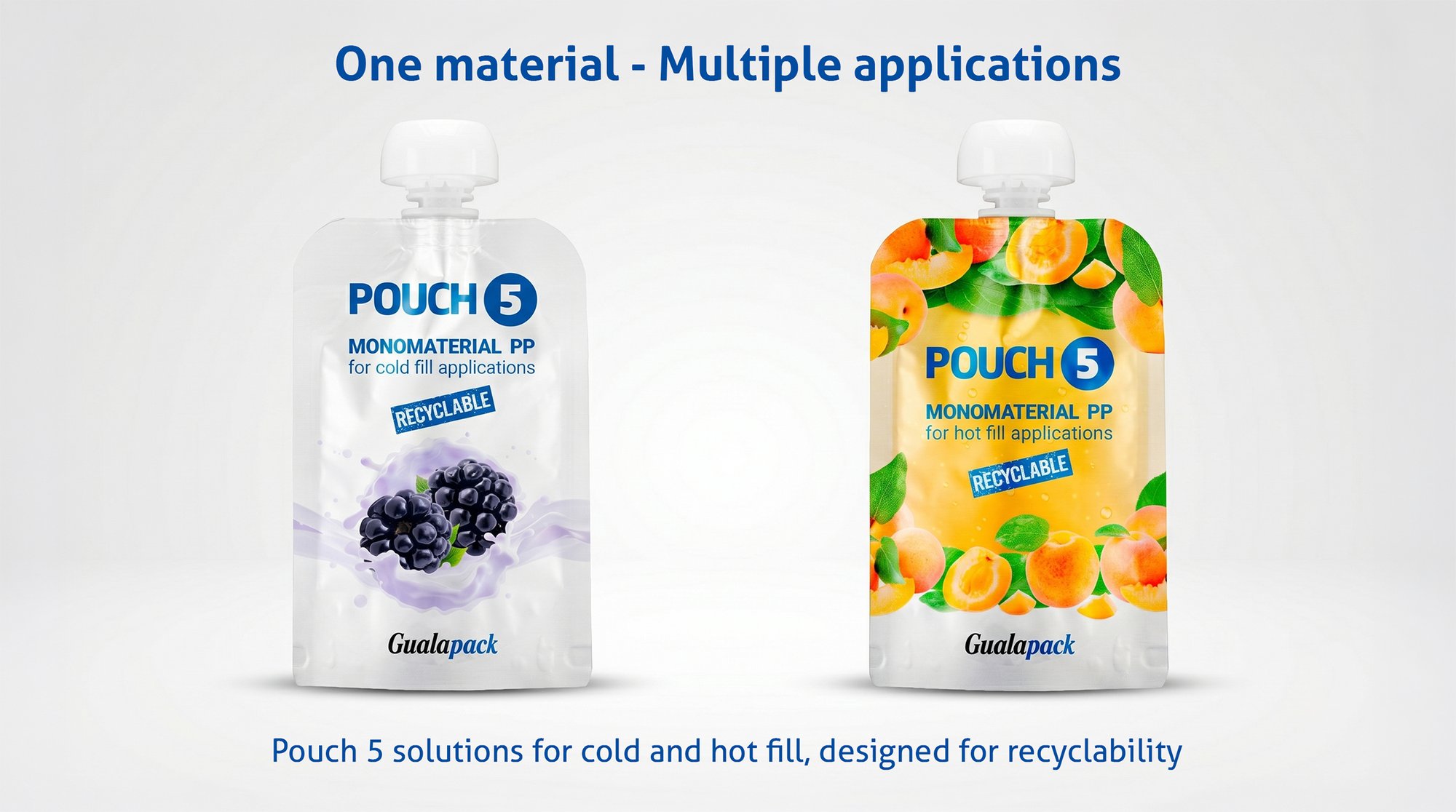
Pouch 5® — a spouted pouch available for both cold-fill and hot-fill products, maintaining functionality while enhancing recyclability.
-
Stand Up Pouch — a versatile format suitable for a wide range of products.
Tethered Cap — a cap that remains attached to the packaging
Since July 2024, this feature has become mandatory for many single-use plastic packaging types in the European Union under the EU Single-Use Plastics Directive. The concept is simple: the cap stays attached to the packaging after opening.
This solution addresses several key environmental challenges:
-
reduces the risk of losing small plastic parts that often escape recycling streams;
-
supports more efficient sorting and recycling, as all components remain connected;
-
helps reduce plastic leakage into the environment.
In pouch applications, tethered caps maintain ease of use while ensuring compliance with current European regulations.
These solutions demonstrate that modern technologies can successfully combine functionality, strong shelf appeal, and circular economy principles.
The packaging industry is evolving: performance is no longer measured only by product protection, but also by what happens after use. Recycling-ready solutions are becoming the new standard, and while the journey toward full circularity continues, today’s innovations are already shaping a more sustainable future.